

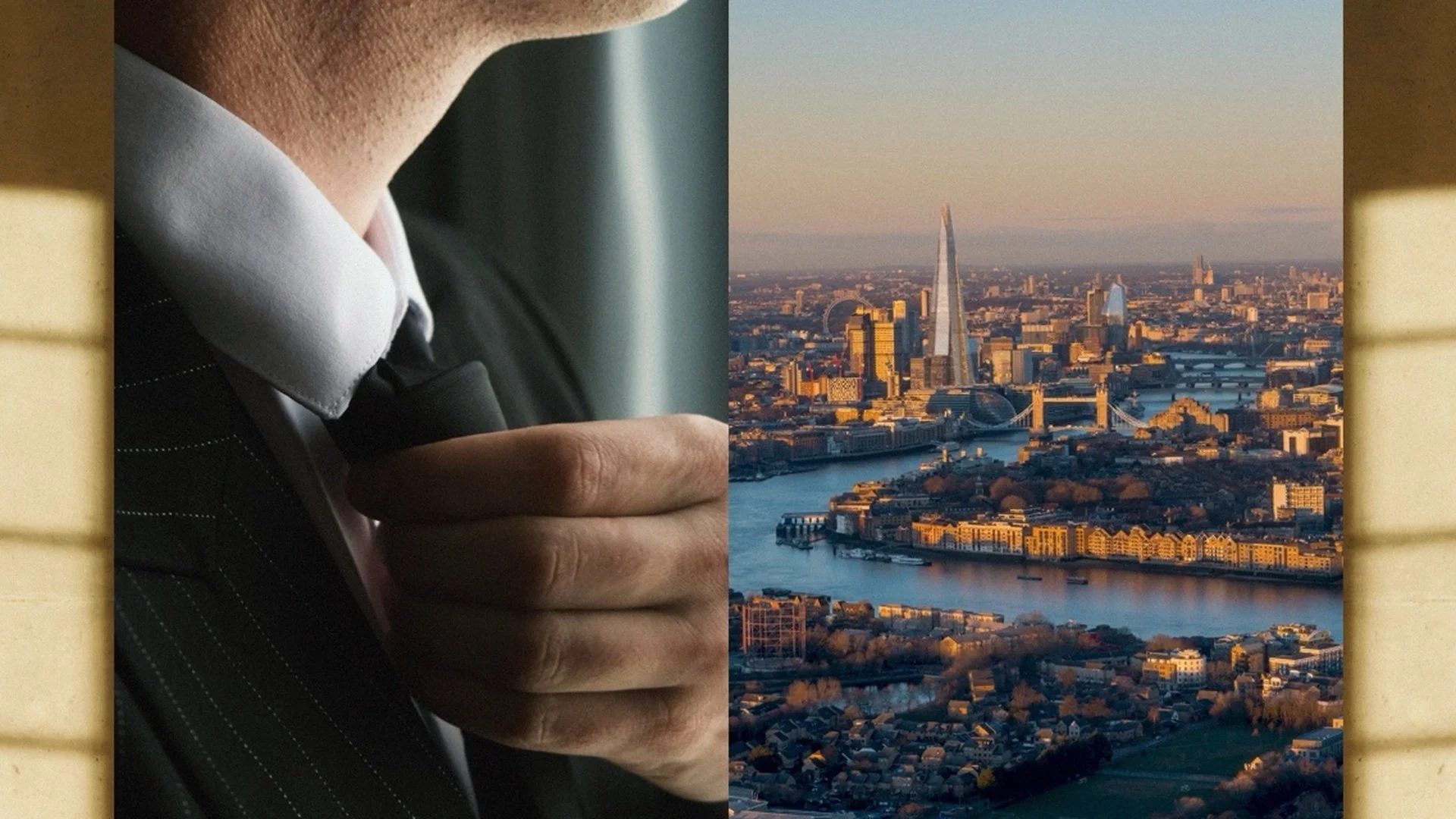
A frame from the immersive film experience presented across three screens at Frameless Gallery
What data cannot do.
The science on climate risk is settled. The reports exist. The numbers are stark. And yet, in the rooms where the biggest decisions are made, it still does not land.
This is the problem Chapter Zero set out to solve. Their mission is to bring climate into the boardroom. Their audience is the chairs and non-executive directors of the largest companies in the country: people fluent in risk, data, and consequence. People who have read the reports and, somehow, still have not been moved to act.
Because here is the thing about climate risk. It is real, it is here, and it is genuinely difficult to grasp. The timescales are long. The systems are interconnected in ways that resist a single chart. The most rigorous research, from the Institute and Faculty of Actuaries and the University of Exeter, shows that current climate models are significantly underestimating the economic impact. That is an extraordinary finding. And on a slide, it disappears.
The problem was never the information. It was the language.
A new language for an old problem.
Most climate communication looks the same. Reports. Graphs. A polar bear, perhaps. Worthy, accurate, and easy to ignore. We wanted to do something we rarely see in this space: use art, music, and genuine production value to make a room full of senior leaders feel the weight of the decisions sitting on their desks.
Chapter Zero asked us to create an experience for their event at Frameless Gallery in Marble Arch. 160 square metres of projection-mapped walls. A 360-degree surround sound system. A six-metre ceiling. A space built to overwhelm the senses. The brief was to move people who are not easily moved.
So we built a story strategy around a single question. What is your legacy?
The multi-sensory, immersive film experience that followed was told through a single collective voice: the inner monologue of a new generation of emerging business leaders. Different voices, different accents, different geographies. Not one person’s perspective, but many. Asking the questions the boardroom has not yet asked.
We wanted to demonstrate the behaviour we hoped to catalyse, rather than request it.

A frame from the immersive film experience presented across three screens at Frameless Gallery
There is no substitute for being in the room.
Something is shifting in how people want to engage with difficult ideas. The appetite for experiencing something in person, together, in a shared space, is growing. A report can be read alone and forgotten alone. An experience is felt collectively, and that changes its weight.
This is what a venue like Frameless makes possible, and it is precisely what we set out to do with this multi-sensory immersive film experience created by our team at STORO. We did not want to send these leaders a film to watch at their desks. We wanted to bring them together, surround them, and immerse them in the challenge. To put them physically within the systems and stakes described by the research.
The event sold out. It launched alongside contributions from Lord Deben, former Chair of the Climate Change Committee, and Emma Howard Boyd CBE, former Chair of the Environment Agency and the London Climate Resilience Review. There is a reason senior figures of that calibre gave their time to a gathering like this. Real dialogue happens when people are in the room together, not when a PDF lands in an inbox.
To shock, then to inspire.
There were two things we needed the work to do. First, to confront. Some of the research findings are frightening, and we did not soften them. The film moves through provocation, through the real vulnerability of the systems we depend on, and does not look away.
But shock alone changes nothing. People who feel only fear shut down. So the second job was to inspire: to show that the boardroom is a place of change, and that proactive decisions today open up genuine opportunity. The score, built from found recordings and organic nature sounds blended with rich strings and intimate piano, carries the audience through optimism, confrontation, and vulnerability, before landing on a note of hope. The music cuts to silence at the close, leaving the room with a question rather than a conclusion.
This is the balance that matters. Confront people with the truth. Then give them somewhere to go.
What actually happened in the room.
Here is the part that matters most. The work did not just feel powerful. It changed what people intended to do.
Chapter Zero surveyed the room. A huge 78% of attendees said they planned to take specific boardroom actions on climate risk. From an initial analysis of more than 50 member perspectives:
40% planned to refresh board skills or training on tipping points and planetary boundaries
38% planned to ask their executive team specific questions on how climate risk is integrated into strategy
30% planned to add climate risk as a standing agenda item for the main board
28% planned to formally update their corporate risk appetite statement to reflect climate uncertainty
22% planned to advocate for a capital allocation shift towards transition technologies or nature-based solutions
And 86% felt the speakers, the scenario exercise, and the film together strengthened their understanding of climate risk.
These are not vanity numbers. These are senior leaders leaving a room with clear intent to change how their organisations govern, allocate capital, and assess risk. That is what moving people looks like when it works.
The response continued beyond the event. The experience travelled to an accompanying reception during London Climate Action Week, featuring Don Robert CBE, Chair of the London Stock Exchange, and Vicky Moffatt, CEO of Chapter Zero. Frameless Gallery asked to retain the work as a permanent showcase for prospective clients, describing it as one of the strongest examples they had seen of content making full use of the space.
Why this one mattered.
We have always believed that the organisations doing the most important work are often the ones who find it hardest to talk about it. Climate risk is the sharpest example of that we have ever worked on. The stakes could not be higher, and the communication challenge could not be harder.
This project proved something we hold deeply. Sustainability does not need more data. It needs a new language: one that uses creativity, art, and emotion not as decoration, but as the very thing that makes complex truth land. With the right ideas and the right people, that language can move a room. And a room like this one moves the rest.
It was a privilege to be part of it.
Read the full case studyhere. Watch the film optimised for YouTube here.














